
How to Hang a Cabinet using a French Cleat
Using a French cleat is the easiest way I’ve found to hang a cabinet on the wall when working alone. You secure one cleat to the wall and another to the cabinet. Then, it’s simply a matter of lifting the cabinet up and sliding it down in place so it locks into the wall cleat. This method can have some downsides so one might have to weigh those against the benefit of being able to hang wall cabinets alone.
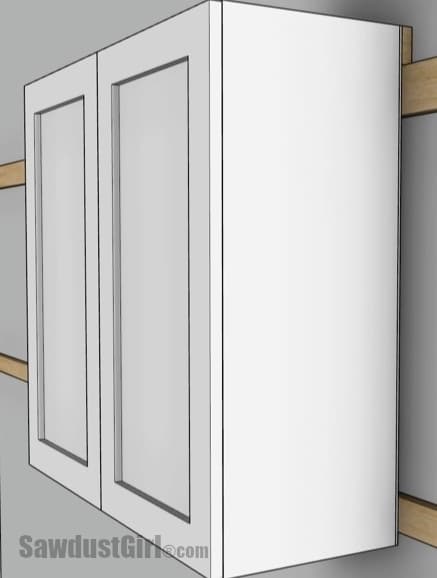
Working alone is how I did 90% of my cabinet installations for 20 years so I had to find ways I could do it all by myself.
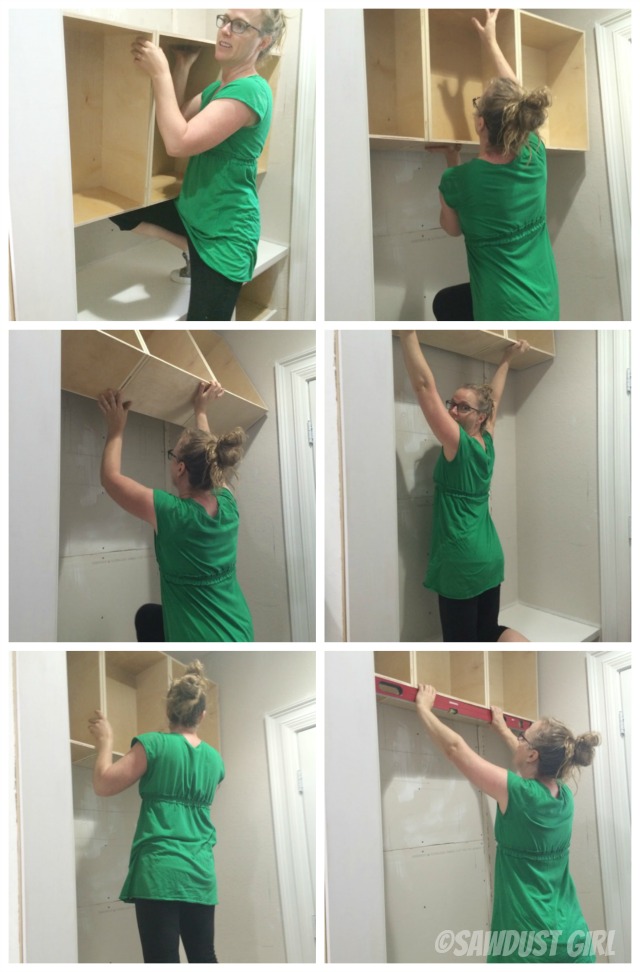
Table of Contents
What is a French Cleat
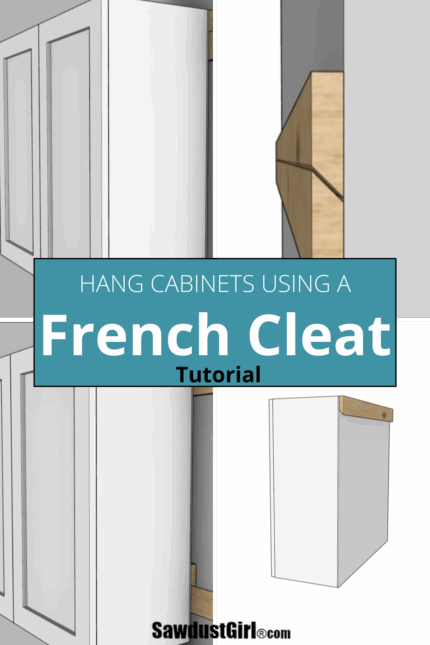
First off, what is it? A French cleat is a mounting system made up of of two beveled, interlocking pieces of wood (or metal but this post is explaining how to create a wood version ). One part is attached to the wall with the angled edge facing upward and away from the wall. The other part is fastened to the back of the cabinet with the angled edge facing downward and away from the cabinet. When the two pieces are slid together, it creates a strong, stable connection.
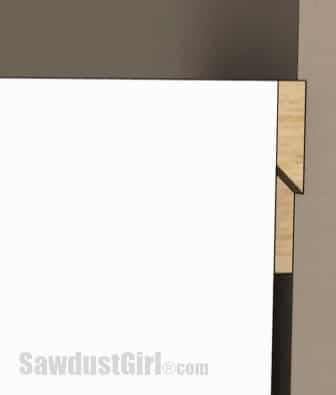
A flat cleat or a ledger board can support the weight of the cabinet but there’s nothing preventing forward tipping. (affiliate link->) Third hands are great in those instances but you generally need an extra set of hands to get the third hand in place while your two hands are holding the cabinet up. The interlocking angles of the French cleat supports the cabinet weight and prevents it from tipping forward, out and away from the wall. This is why the French cleat is such a good single person installation method.
Optimal Size for Wood French Cleat
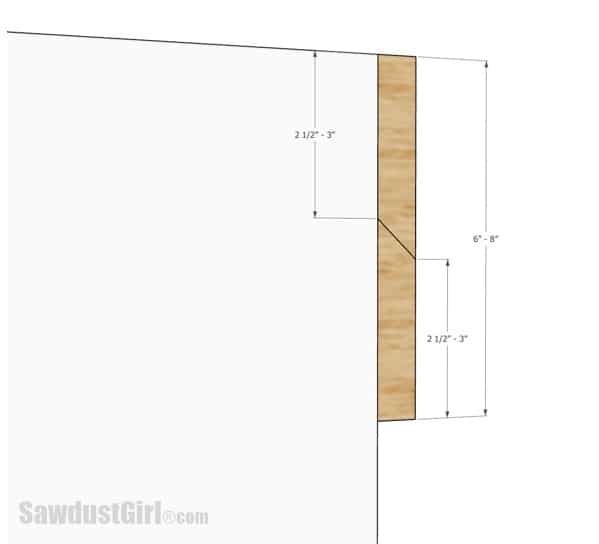
I like to use 3/4″ plywood because it’s strong and typically doesn’t bow or warp like solid wood does. (Though in the photos for this post I’m using a piece of Red Oak that I had it in my scrap pile.) Anywhere from 3″- 4″ is optimal for each cleat part. I would not want the solid portion (before the angle) to be any less than 2 1/2″ wide.
How to Cut a French Cleat
The table saw is the easiest way to cut and bevel a French cleat though one could use a track saw or even a skill saw using guide and clamps.
- First, rip a 6″- 8″ wide strip of plywood
- Next, set the sawblade to a 45 degree angle
- Now, cut straight down the center of that strip creating two mating, angled cleats
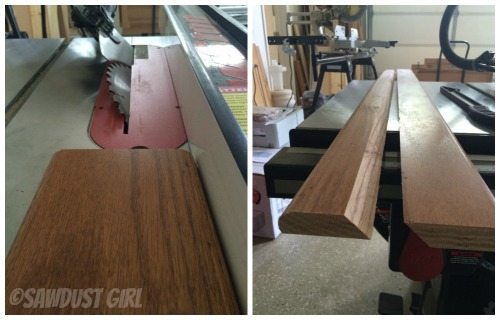
It’s not necessary for the cleat parts to be exactly the same size but makes it easier for installation purposes. Since the wall cleat needs to be mounted lower on the wall by the width of the cabinet cleat, making the two cleats equal in width makes measuring, marking and installing a bit easier.
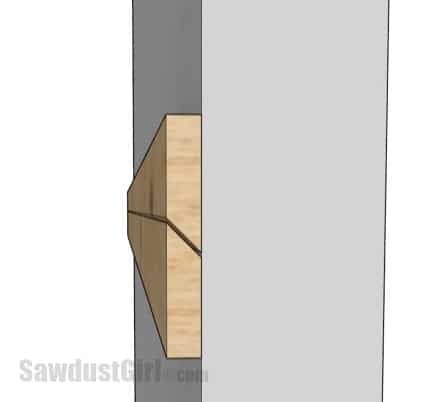
How to Install French Cleat Parts onto Cabinet and Wall
I have installed the cabinet part to the French cleat systems with the angled edge facing the wrong direction. So let’s reiterating the correct direction for your benefit.
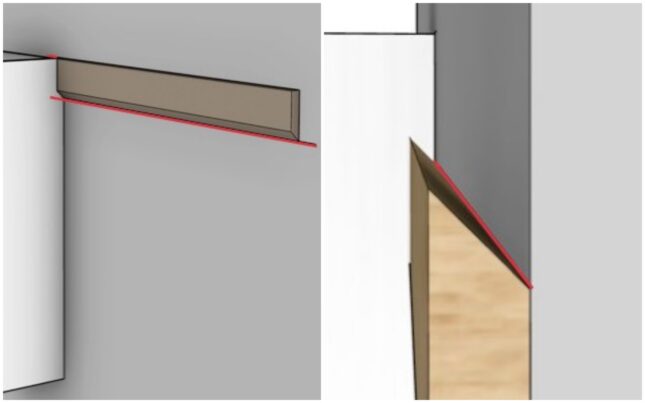
- Wall cleat is installed with the angled edge facing up and out, away from the wall.
- Cabinet cleat is attached with the angled edge down and facing toward to the cabinet.
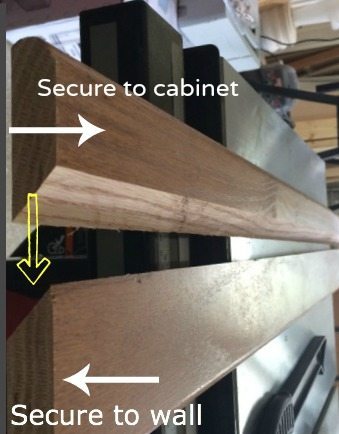
Install Cabinet Cleat
I find it easiest to secure the cabinet part at the top of the cabinet so I don’t have to do any extra math to figure out where to install the wall cleat. Again, angled edge down and facing toward to the cabinet. How you attach the cabinet cleat to the cabinet will vary depending on how the cabinet was constructed.
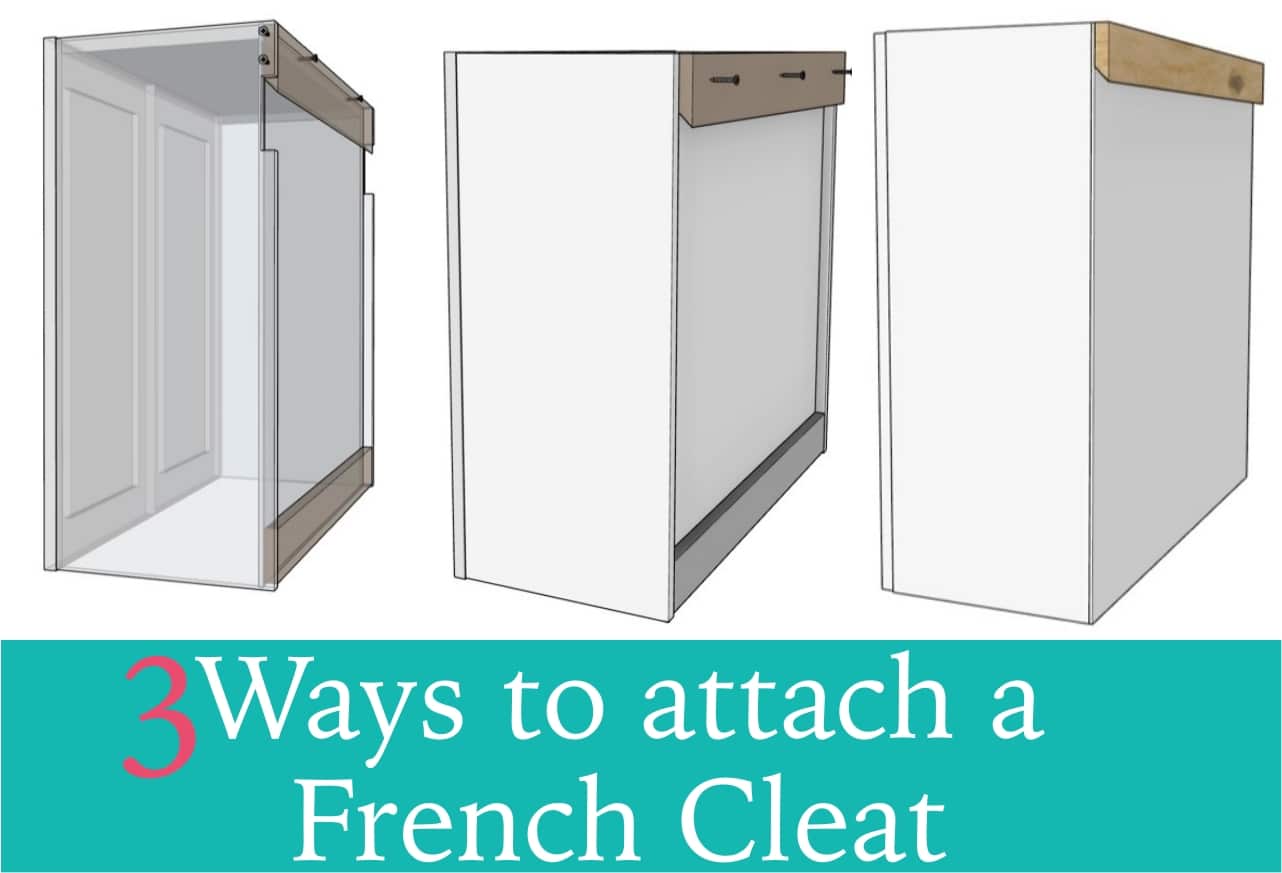
Cabinet with Plant-On Back
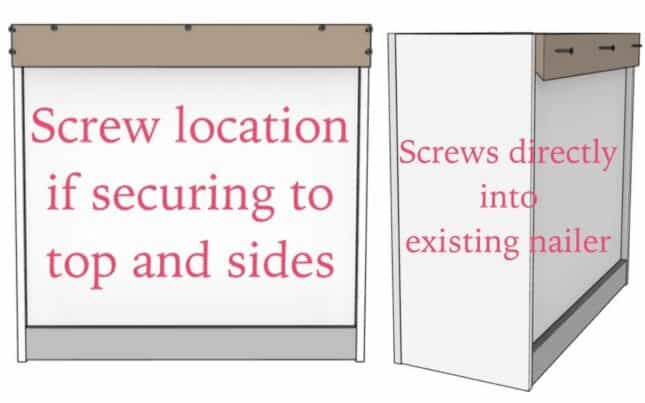
If working with an already built cabinet that has a “plant-on back” (meaning the cabinet has no back recess). You should be able to screw the French cleat to the top and sides of the cabinet, and/or directly into the cabinet back if it is thick enough material, and/or to the nailers. Examples:
- If the cabinet back is made of 1/2″-3/4″ material with no nailers:
- attach the French cleat into the cabinet back with screws of the appropriate length for your particular cabinet parts (don’t screw through and into your cabinet)
- and/or screw the French cleat to the top and sides of the cabinet. #8 1 3/4″ screws would be sufficient.
- If the cabinet has nailers inside with a 1/4″ back screwed or stapled on:
- attach the French cleat to the top and sides of the cabinet using #8 1 3/4″ screws
- and/or screw the French cleat through the cabinet back and into the nailers with screws of the appropriate length for your particular cabinet parts (don’t screw through and into your cabinet)
- Additionally, IF your cabinet has a recess with an existing nailer and you wanted to attach the French cleat to that nailer without cutting a notch into your cabinet you would follow these same guidelines.
Downside to French Cleats attached to Back of Cabinets
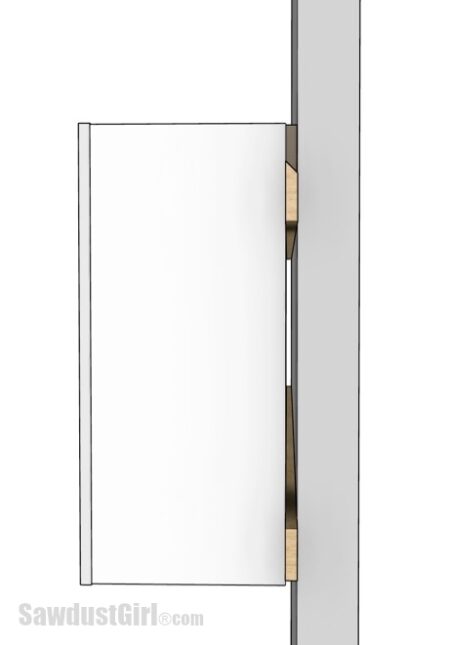
The downside to using a French cleat system where the cabinet cleat is attached to the back of cabinet is that you’ll end up with space behind the cabinet. This generally wouldn’t be an issue if the sides of the cabinet or run of cabinets are hidden and if an extra 3/4″ of depth isn’t going to ruin your overall design. Note that you also need to add an additional bottom cleat or nailer to keep the cabinet plumb.
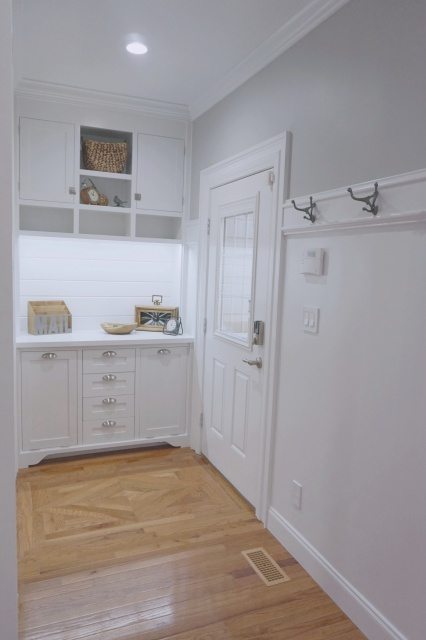
This wasn’t an issue in the kitchen side entry cabinet configuration I was working on when I created this post. If you’re interested how it turned out- voila!
Cabinets with a Back Recess
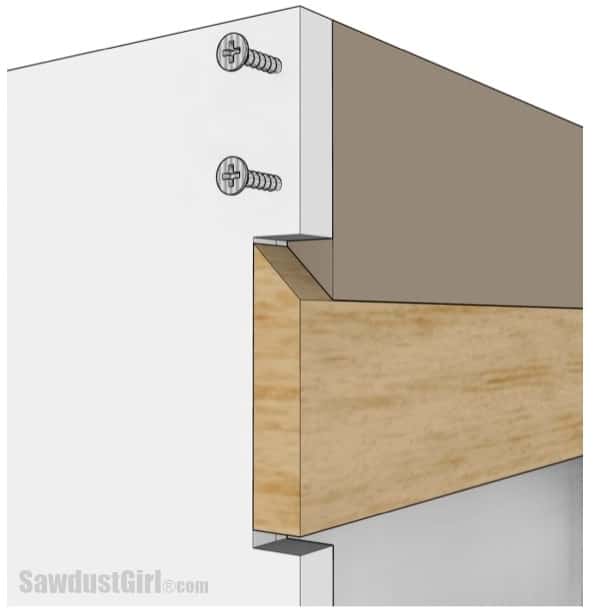
Ideally the cabinet part of the French cleat system is installed into a recess in the cabinet with a notch cut out for the wall cleat. This way you don’t create extra space behind the cabinets when installed. If the cabinets are not hung in a nook and you need to hide the visible ends it can be done with beadboard, or an applied panel that matches you doors, etc.
- The notch can be cut out of an existing cabinet using a jigsaw. Make sure to cut the notch lower than the width of the wall cleat by at least the thickness of the cleat. 1″ – 1 1/2″ is sufficient for a 3/4″ thick cleat and will leave enough space for the full cleats to slide together and interlock.
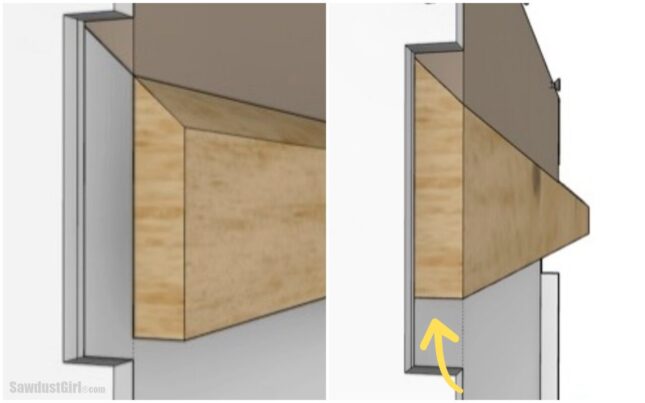
- On a cabinet that has a nailer attached that can not be easily removed because of the construction method, simply attach the French cleat below the nailer. The only attachment point here would be with screws through the cabinet sides and into the cleat (if the cabinet back is 1/4″ thick which is generally the case with cabinets that have backs in front of a recessed nailer.
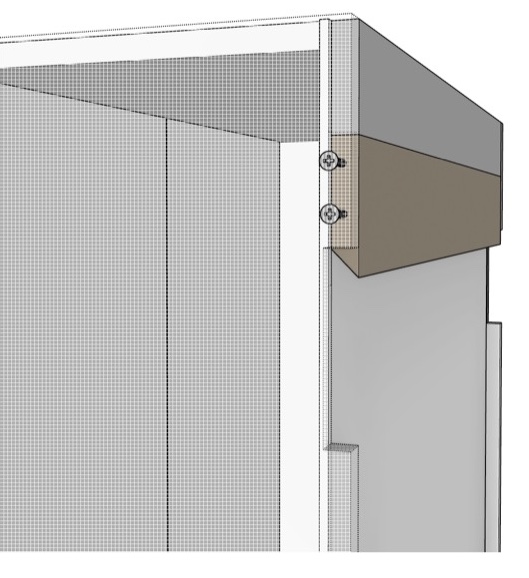
- Use a French Cleat in place of the top nailer. The cleat can then be secured to the cabinet sides and top. This would work on:
- an existing cabinet with a nailer that is screwed in place that you can easily remove
- on a new cabinet that you are building
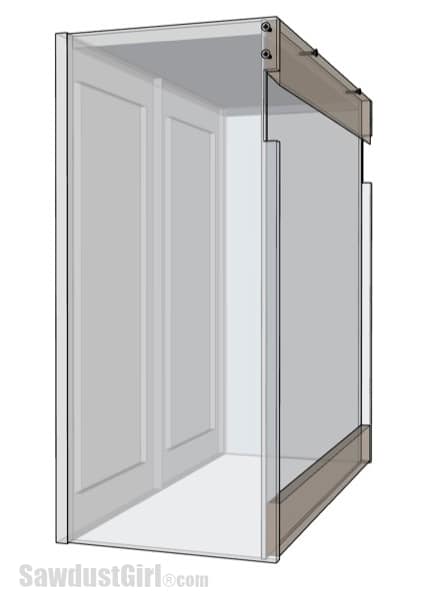
These were three small, light boxes that I joined together and then attached a long French cleat. On larger cabinets, each cabinet would receive it’s own cleat. In those instances I hang each cabinet on the wall cleat and then screw the cabinets together.
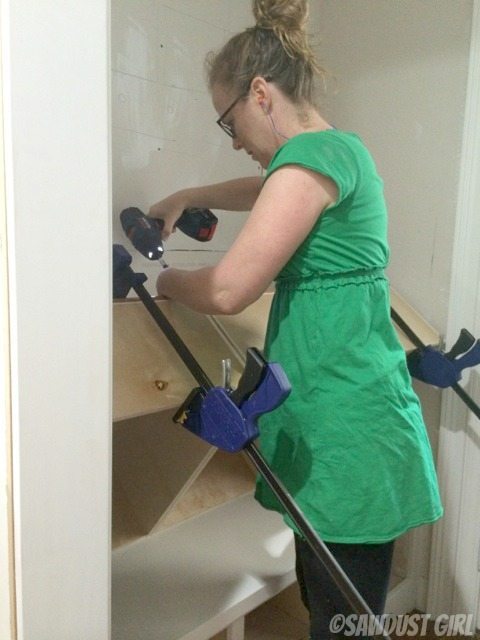
Install Wall Cleat
This is how I do it because relying on math doesn’t always pan out for me:
- Mark on the wall where the top of the cabinet will be.
- Place the cabinet cleat against the wall and mark the bottom.
- Use a level and draw a level line across the entire length of the cabinet installation space.
- Then line up the top of the wall cleat minus the angle with that mark
- This requires looking over the top of the wall cleat so you can see the line
- Put a couple nails in it and check again for level – adjust as needed
- Secure wall cleat to the studs using 2 1/2″- 3″ screws.
Hang the Cabinet on the Wall
Now you just have to lift the cabinet up past the cleat then let it slide down the wall and nestle into place so the two cleats interlock.
Do one more check to make sure you’re level and plumb. If you put your cleats on level, your cabinet should already be level but you may need shims to get plumb. Now I drive screws through the cabinet into the wall cleat and/or through the bottom nailer into the studs. This keep the cabinets in place and add smore strength and support so the whole cabinet isn’t only hanging on the top cleat.
If you found this tutorial useful you might like my Cabinet Building Ebook or all my free cabinet building tutorials.
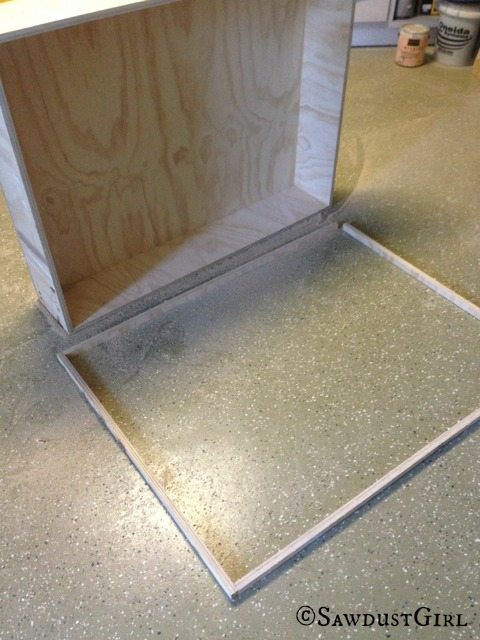
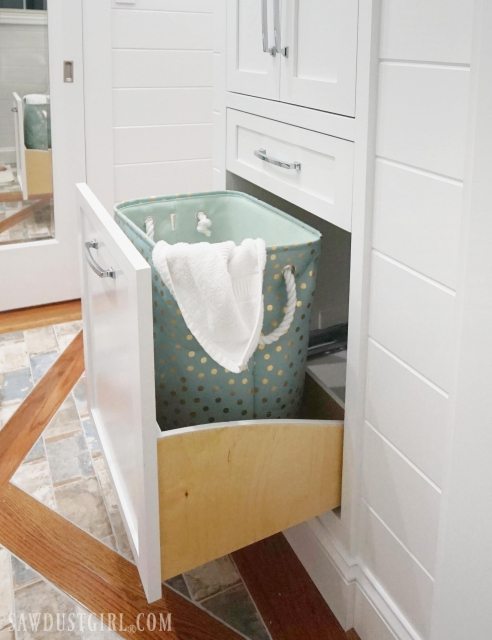

I bought a bed with 3 drawer high for the base of the bed. It was toooooo tall, so I did what any resourceful sawdust loving girl would do. I took a set of drawers off to lower the bed to a reasonable height. Then started the dilemma of what to do with 2 – 6 foot by 2 foot by 8 inch sections of drawers.
Then the light bulb came on, but started more questions. I am setting up our garage for a garage for a new car, storage for different things, and a sort of workshop. What better place to use a set, but as a work bench. It would have storage, a place to work, and still have things on the wall above.
Question 1. How do I hang it? Answer 1. French Cleat
Question 2. How big should both sides of the cleat be? Answer 2. ???
Question 3. I haven’t gotten there yet, but more will probably come up.
Thanks
Wow it sounds like you’re being really resourceful! Making things work and using things for other things… Not that this is the right answer for your situation, but I cut my French cleats about 3″ wide.
Thank you for answering. I usually have to go to the box store for answers, but you can’t always rely on their expertise..
I had been on your site before, but didn’t realize you were in my backdoor, so to speak. I guess us Tennessee Girls aren’t afraid to work hard, and share what we learn.
What would you use instead of the French cleat? I want to make the bank of drawers like a floating set.
Also, when you say 3 inches, are you saying both sides make 3 inches for a total of 6, or 3 inches total?
Go Vols
There’s a few factors that would sway decisions: cabinet construction, how are you securing the French cleat, weight of loaded cabinets (what I can currently think of)??? I generally use a 2 1/2 – 3″ cleat on the back of my cabinets to secure them to the wall. If planning to use a french cleat system, I’d make that a French cleat and adjust how I construct the cabinet so the French cleat is secured to the cabinet without obstructions so it could be used to hang the cabinet.
Alternately, you can purchase metal french cleat cabinet hanging systems. Like what you use to hang IKEA cabinets.
Sawdust Girl! Love the name of your blog and I am seriously inspired. I have built chicken coops and greenhouses and tables before, I have refinished everything under the sun including painting kitchen cabinets and always admire women who are just plain and simple- doing it themselves! Bravo!
May seem obvious, but steps 2 and 3 above assume that both parts are equal in height, true? Thus the instruction to move the top of the wall cleat to the mark at its bottom, essentially offsetting the cleat by the same height as the cabinet cleat.
We have an antique mantel that we want to stabilize (no fireplace – just decorative). Would you suggest pocket screwing the mantel cleat to the underside of the mantel top? This is just to avoid tipping – the mantel will stand on the floor.
Thanks for a great explanation.
It doesn’t matter if the cleats are the same size or not. You put the cabinet cleat in place (where it will be when it’s attached to the cabinet and setting against the wall. Then you put the wall cleat in place, based on the location of the cabinet cleat.
If you are building a mantel, you could certainly build it with a french cleat recessed. If the mantel is already built and you are thinking of attaching a french cleat to it, it will push the mantel away from the wall by the thickness of the cleat. Might not be the best choice in that instance.
What is the minimum thickness for the back of the cabinet to use a cleat?
I secure the cleat to the cabinet sides which are 1/2″ or 3/4″. I would only secure it to the back if the cabinet back was 1/2″ and secured to the cabinet with screws.
Thanks for the quick response!
I love your site.
Are you screwing the cleat directly into the end gain or the plywood or are you using pocket holes?
can anyoe ask a question or is this strickly a female deal. I have aquest about the Fr cleaton kit cab the sides leave aspace in back would a fr cleat work if it was cut to fi in the space and the cleat bult out so the cabinet would be flush to th wall would this work or not? I have a whole set of kit cabinets to do by myself. I am looking for ways to hang them sceurely what about crooked walls that are out of plumb what do you do about that? just looking for answers is all. I don’t mean to intrude
Anyone can comment and ask questions and I do my best to answer. 🙂 If you are building your cabinets from scratch you can certainly just install a french cleat instead of a regular cleat and you could recess it by installing the cabinet back in front of the cleat in a dado. Or, if you don’t want to go to the effort of dadoing all your cabinet backs so you cleats are invisible from the side, you only really need to worry about the end cabinet. That’s the only one you see from the side. Right? Build that one differently so the side covers the space created by the French cleat.