How to sand projects to get a professional finish.
Kellyn here to share tips on how to sand like a pro! You may have seen my posts on The Sawdust Diaries. And I am so excited and honored that Sandra asked me to contribute some of my building knowledge here on her Sawdust Girl blog.
Sanding 101 – sanding basics
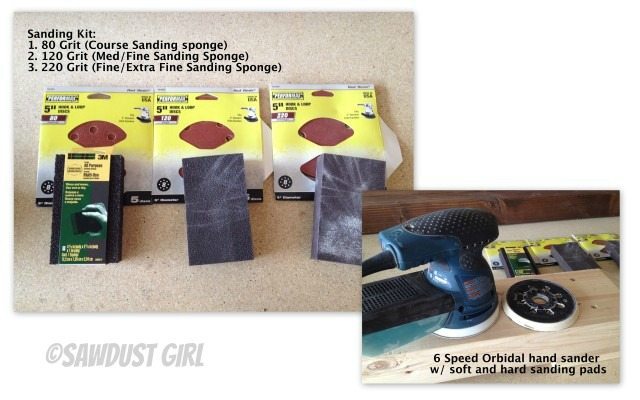
I always have on hand the following sanding tools:
1. 80 Grit sandpaper (Course/Med Sanding Sponges)
2. 120 Grit sandpaper (Med/Fine Sanding Sponges)
3. 220 Grit sandpaper (Fine/Extra Fine Sanding Sponges)
I also have a Bosch 6 Speed Random Orbital Sander that I love, and use on pretty much every project.
Side note on orbital sanders: There are 2 kinds of pads ( the round disks that the paper sticks to.)
Hard- for flat surfaces and fast material removal. (I use this when I am sanding down large flat surfaces)
Soft- for general purpose sanding and polishing. (Use for everything. But I notice that the soft pad’s middle starts to concave and will leave round marks on large flat surfaces.)
Now, this is not rocket science, the steps are fairly easy:
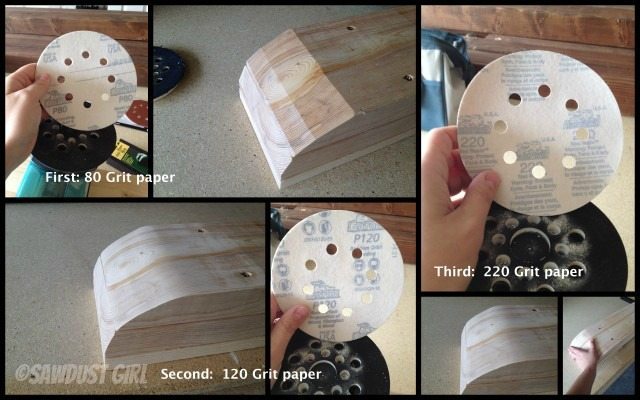
Step 1: Use the 80 Grit sandpaper (Course/Med Sanding Sponges) to smooth out all defects, gouges, scrapes… or in this case my example is to round out the curves. The 80 Grit is rough, and is used to mould or remove large amounts of material faster.
Step 2: Use the 120 Grit sandpaper (Med/Fine Sanding Sponges) to buff out the harshness from the 80 grit sand paper. When you run your hands over the wood, you should be able to tell the difference immediately from the 80 Grit.
Step 3: Finally, use the 220 Grit sandpaper (Fine/Extra Fine Sanding Sponges) to polish off your work. This is the best step and leaves the wood nice and smooth and ready for paint or stain.
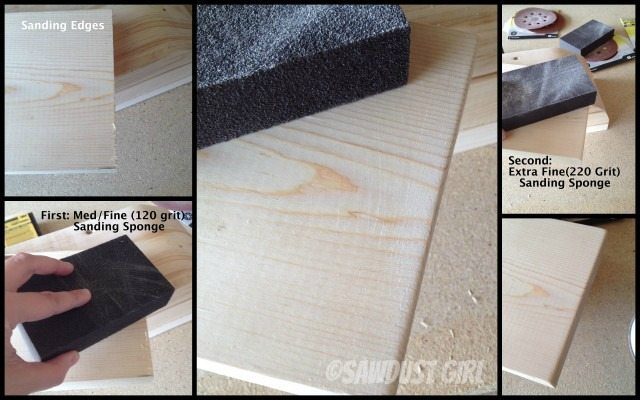
When sanding down edges of boards, I usually stick to the Med/Fine and the Extra Fine Sanding sponges. It’s quicker to go over them with the sponges, and doesn’t take much before you have nice clean edges.
Don’t forget to sand. It is a tedious and long process, especially if you have been building a project for a long time. Sometimes I am spending full days of just sanding. But it is well worth it in the end. Happy Sanding!